Radar Level Transmitter
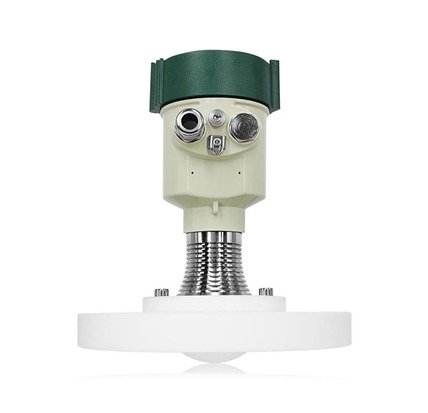
Measuring level inside a tall silo or a hot, closed vessel is harder than it looks. Dust scatters sound waves, steam fools many probes, and heat or pressure can wear sensors out. Radar avoids most of these problems, because radar waves travel through dust, vapour and fog far better than sound does, and nothing has to touch the product.
Levtron's answer to those conditions is the FMLT-1800LS, an 80 GHz FMCW radar transmitter made in India and supplied to industry in Pune. Below you will find how it measures, where it works best and the figures most buyers check first.
What Is a Radar Level Transmitter?
A radar level transmitter measures the distance to the surface of a liquid or solid using microwaves and converts that distance into a level reading. The FMLT-1800LS uses frequency modulated continuous wave (FMCW) radar. It sends out a wave whose frequency rises steadily from 76 GHz to 81 GHz. The wave reflects off the product, and the returning echo differs slightly in frequency from what the transmitter is sending at that moment. A digital signal processor turns that beat frequency into an exact distance, and from it the level.
Why Choose Radar Level Transmitter From Levtron?
Radar is an advanced technology, and the antenna, range and mounting details matter. Here is what Levtron offers buyers in Pune:
- Made in India, Checked Before Dispatch: The FMLT-1800LS is made in India, and every unit is tested and calibrated before it leaves the factory.
- Antenna and Connection Choices: Lens antennas in PTFE or PEEK, a quartz isolation option, and threaded or flanged connections allow the transmitter to be matched to the vessel.
- Part of a Wider Level Range: Levtron also makes ultrasonic, capacitance, hydrostatic and float transmitters, so radar can be compared honestly against other options.
- Technical Help in Pune: Levtron is located in Pune, so local buyers can discuss the product, vessel and conditions with the manufacturer before ordering.
- Catalogue and Manual Available: A product catalogue and user manual are published on the Levtron website, which supports selection, wiring and commissioning.
Applications of Radar Level Transmitters
- Deep Silos and Bulk Solids: Cement, fly ash, lime, grain, ore and plastic pellet silos produce heavy dust, and radar reads the level through it continuously.
- Liquid Storage and Chemical Vessels: Acids, alkalis, solvents, fuels, wastewater and syrups can all be measured without any probe touching the liquid.
- Agitated and Turbulent Tanks: The high-frequency signal ignores agitator blades, surface ripples and foam, which often upset other technologies.
- High-Temperature, High-Pressure Vessels: The transmitter withstands process temperatures up to +200°C and pressures up to 2 MPa (20 bar).
- Aggressive Corrosive Media: A PTFE lens antenna shield, a quartz isolation flange and anti-corrosion materials are available for harsh chemical duties.
- Tall Process Vessels: A measuring range of up to 120 m and a narrow beam suit tall columns and vessels with nozzles and internal fittings.
In each case, the transmitter provides continuous level data to a DCS, PLC or telemetry system.
Salient Features of Radar Level Transmitters
- 76 to 81 GHz FMCW Technology: Millimetre-wave radar built on a CMOS RF design, with a 5 GHz sweep that gives high range resolution and a clean echo.
- ±1 mm Accuracy, Range to 120 m: Measurement accuracy is ±1 mm, with standard ranges of 35 m and 85 m and a maximum of 120 m, so one technology covers small and very tall vessels.
- Narrow 3° Beam Angle: The standard lens has a 3° beam, with an 8° option, which limits reflections from vessel walls, nozzles and internal obstacles.
- Immune to Dust, Steam and Pressure: Non-contact measurement is unaffected by dust storms, steam, fog, vacuum and high pressure, with a blind zone of only 0.1 m.
- HART and Modbus Outputs: A 4 to 20 mA loop with HART protocol and RS485 Modbus RTU output, in 2-wire (18 to 28 V DC) or 4-wire versions.
- Graphic Display With Diagnostics: A backlit LCD shows the echo curve, and false-echo mapping lets the transmitter ignore fixed obstacles in the vessel.
- Housing and Process Connections: Die-cast aluminium (IP67) or SS316 housing, two M20 x 1.5 cable entries, G1-1/2 inch or 2 inch NPT threads, or DN50 to DN200 flanges.
Benefits of Choosing the Right Radar Level Transmitter
- No Contact With the Product: Nothing touches the material, so there are no probes to coat, corrode or wear, and maintenance stays low.
- Steady Readings in Difficult Conditions: Dust, steam, foam and condensation do not disturb the signal, so the reading stays reliable where other technologies struggle.
- Accurate Inventory Figures: Continuous millimetre-level readings give a precise picture of what is in a vessel, which supports ordering and dispatch planning.
- Less Need to Climb Silos: Operators no longer have to open hatches or climb to measure level, which removes a risky routine task from the working day.
- Fits Common Control Systems: Standard 4 to 20 mA, HART and Modbus outputs connect to most PLC and DCS systems without special converters.
- Wide Operating Window: Process temperature from -40°C to +200°C and pressure from -0.1 to 2.0 MPa cover a broad range of demanding vessels.
Radar Level Transmitter Supplier in Pune
Levtron Instruments supplies radar level transmitters to industrial plants, process units and storage facilities in Pune, for industries such as cement, chemicals, food, pharma and water treatment.
To help select a model, share the product, vessel height, temperature, pressure and the output signal you need. Please confirm delivery timelines for Pune with our team when you enquire.