Fuel Level Transmitter
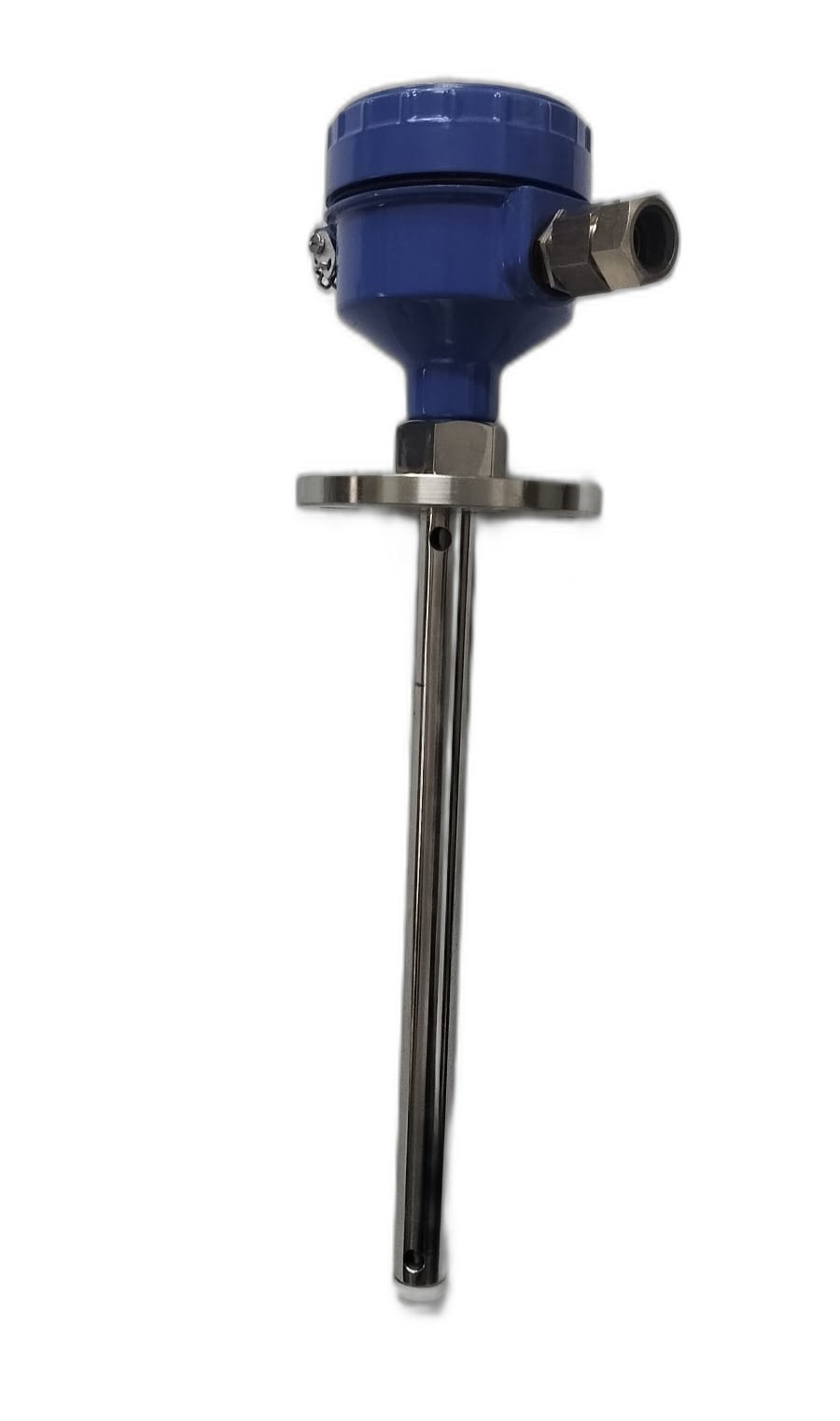
Ask anyone who looks after a diesel generator how they check the tank and most will describe a stick, a torch and a guess. It works fine until the night it doesn't. A fuel level transmitter does that job all day without being asked, and it tells the control room, not just whoever happens to be standing next to the tank.
We make the CPLT-1200F at our unit in Pune. It's a capacitance fuel level transmitter for diesel, petrol, ethanol and oils, and Levtron Instruments Pvt. Ltd. supplies it to plants, DG set sites and fuel depots across Maharashtra, as both manufacturer and supplier.
What Is a Fuel Level Transmitter?
A fuel level transmitter reads how high the fuel is in a tank and sends that number out as a 4 to 20 mA signal. Your PLC, panel or remote system picks it up. From there you can show the level, log it, or set an alarm for when it drops too low.
The CPLT-1200F gets its reading from capacitance. There's a sensing rod in the middle and a steel tube around it. As fuel rises into the gap between them, the capacitance changes. Fuel and air respond differently, so the change follows the fuel height in a straight line.
Why Choose Fuel Level Transmitters From Levtron?
Fuel is expensive and flammable, so the instrument has to be right and safe. Here's why people buy ours:
- Made Here, Tested Here: Every CPLT-1200F is made in India and tested and calibrated before it leaves, so it's already been proven.
- A Number You Can Use: Plus or minus 0.5 per cent of full scale, with 0.5 mm resolution, is close enough to run stock records on, not just to eyeball a tank.
- Built for Flammable Places: The Ex-d flameproof IP66 enclosure is certified for hazardous fuel storage, which is where most fuel tanks end up sitting.
- Doesn't Care About the Tank: The grounding tube is part of the sensor, so it works the same in a steel drum, a plastic tank or an odd-shaped bunker.
- Set Up for Your Fuel: We calibrate each one for the dielectric constant of your fuel before dispatch, and you can trim the span on site if you need to.
Applications of Fuel Level Transmitters
- Diesel Generator Tanks: Watch the level, track how much the DG set really burns and notice when fuel goes missing at night or over a weekend.
- Fuel Depots and Underground Bunkers: Keep stock figures for diesel, petrol, bio-diesel, kerosene and aviation fuel without dipping the tank by hand.
- Generator Day Tanks: Get a clear warning before the day tank that feeds an engine runs low, so the set never stops because nobody refilled it.
- Oil Reservoirs: Watch lube skids, hydraulic oil tanks and turbine governor sumps, where a falling level means a problem somewhere in the circuit.
- Solvent and Chemical Lines: Measure ethanol, methanol, toluene and paints safely, where a spark from ordinary electronics isn't acceptable.
- Plastic and Fibreglass Tanks: No metal wall needed. The sensor carries its own reference, so non-metallic tanks can be measured just as well as steel ones.
- Vehicles and Mobile Equipment: Runs on a 12 V automotive supply and copes with sloshing, so fleets and moving machines can report fuel level too.
Salient Features of Fuel Level Transmitters
- Concentric SS316 Tube: A stainless steel ground tube with PTFE spacers sits around the sensing rod, which keeps readings steady whatever shape the tank is.
- Half a Per Cent Accuracy: Plus or minus 0.5 per cent of full scale and 0.5 mm resolution, so small changes in level actually show up.
- Flameproof Enclosure: A die-cast aluminium Ex-d IP66 housing, with a 1/2 inch NPT or ET cable gland, made for hazardous and flammable areas.
- Pre-Calibrated at the Factory: It's set for your fuel's dielectric constant when it's built, with a simple span trim on site if conditions differ slightly.
- Isolated 4 to 20 mA Output: Sends a clean current loop to PLCs, RTUs and telemetry units, with RS485 Modbus RTU, 0 to 5 V or 0 to 10 V as options.
- Anti-Slosh Damping: Digital filtering takes the jitter out when fuel moves around, so a bouncing vehicle tank still gives a steady number.
- Nothing to Wear Out: No floats, no sliding contacts and no potentiometers, so there's nothing to jam or wear down over the years.
- Lengths and Fittings: Measuring lengths run from 200 to 2000 mm, with custom lengths up to 3000 mm, and 1 inch or 1.5 inch BSP or NPT threads.
Benefits of Fuel Level Transmitters
- You Always Know the Level: No more dipsticks or guessing, and no more finding out on a Monday that the tank has been empty since Friday.
- Theft and Leaks Show Up: A sudden drop with no matching consumption stands out in the record, which is often the first clue that something's wrong.
- No Surprise Shutdowns: Alarms and trend data give you time to refuel properly, so generators and equipment don't stop at a bad moment.
- Fuel Costs Make Sense: Continuous data lets you compare consumption across DG sets and sites and see where the money goes.
- Safe Where It Counts: The flameproof enclosure suits flammable storage, so people on site don't have to trade safety for a reading.
- Very Little Upkeep: With no moving parts to wear or stick, there's very little to maintain once it's installed and calibrated.
- Plugs Into What You Have: Standard 4 to 20 mA and optional Modbus connect to the PLCs and telemetry you already use, with no special interface.
Fuel Level Transmitter Supplier in Pune
Levtron Instruments Pvt. Ltd. supplies the CPLT-1200F fuel level transmitter to factories, DG set installations, fuel depots, workshops and process plants across Pune and Maharashtra. We build it at our unit in Shivane, Pune, so we can tell you plainly which length, fuel setting and connection will work in your tank. We also make other level transmitters, switches and indicators. Tell us the fuel, the tank size, your supply voltage and the output you need, and our team will suggest the right configuration.